
MARKET REPORT
Andalucía Market Report 2026

Click on any of the images to open larger versions.
Introduction
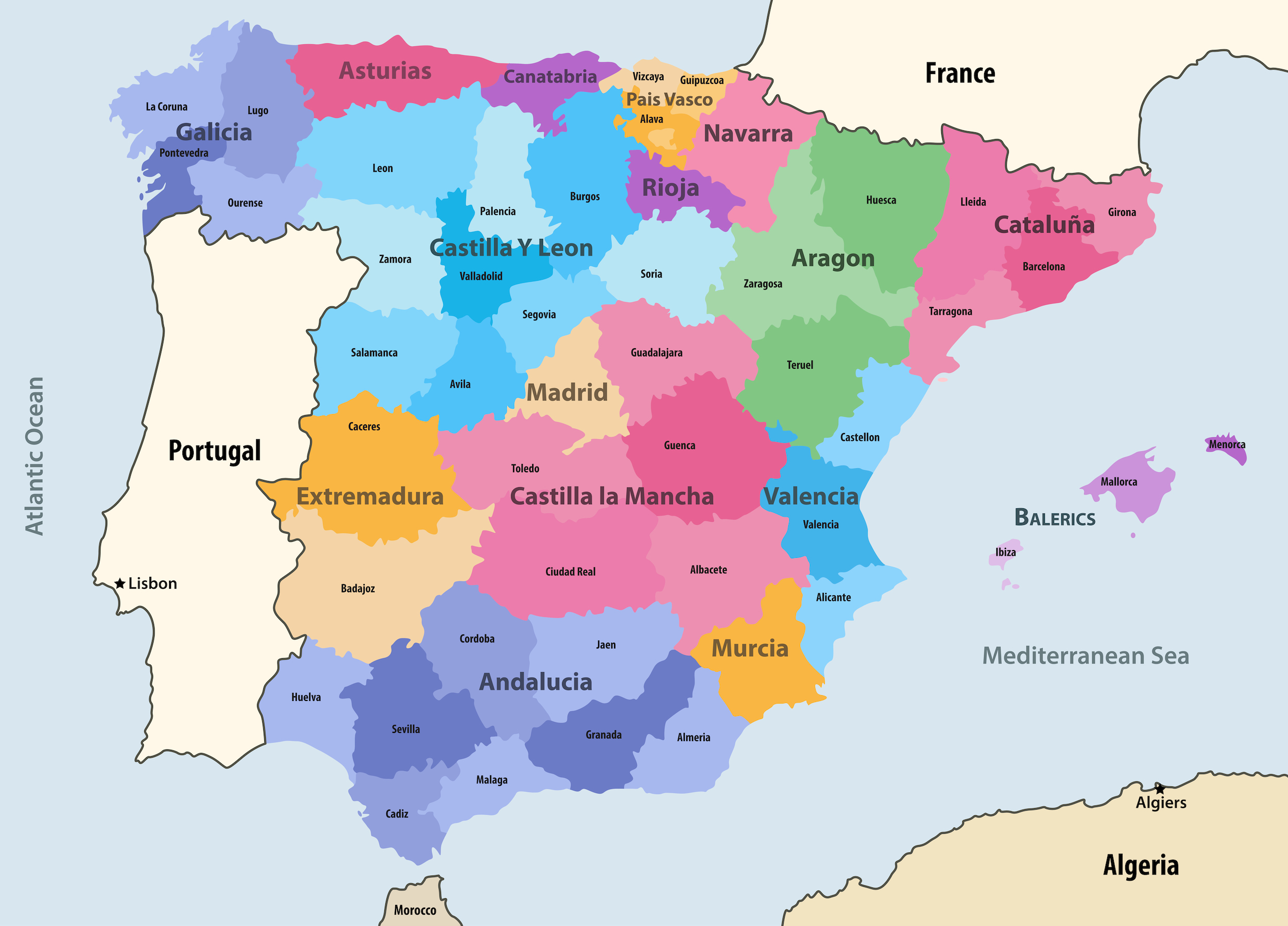
Map of Spain showing the 17 autonomous regions
Before diving into the detail, these headline points summarise the current shape of Andalucía’s property market:
- Andalucía accounted for around 19.5% of all 2025 property transactions in Spain, confirming its role as a core national market
- Overseas buyers represented approximately 19% of purchases region-wide, but their impact is highly concentrated in a small number of prime locations
- In Málaga province, foreign buyers accounted for 42.9% of transactions, rising to over 60% in Marbella and more than 80% in Benahavís
- Prices vary sharply by location. While the regional average was €1,663 per m², prices in Málaga province were around 68% higher
- New-build homes represented less than 10% of transactions, highlighting structural under-supply, not overbuilding
- Looking ahead to 2026, strong international demand and limited supply in prime areas are expected to keep upward pressure on prices
Buying a property in a market you know well, in which you understand the legal system and speak the language, is one thing. Searching in another country you may only know from family holidays, where you are unfamiliar with how the legal system functions and don’t speak the language, is quite another. But that’s the situation in which many buyers from overseas find themselves when planning a purchase in Spain. Good research, and an understanding of market evolution over time and market trends going forward, particularly with reference to prices and locations, is essential. However, getting access to reliable statistics has not always been easy in Spain. The main reason for that is the two principal sources of property market statistics, the Notaries and the Property Registries, produce figures that differ by as much as 25% because they count when a purchase takes place differently. That’s confusing for buyers who want to know if the market is trending up or down, current prices, prime locations, and lots of other issues.
Spain has 17 autonomous regions, some of which have very low numbers of foreign property buyers, while in others overseas purchasers have a market share as high as 40%. However, at the autonomous regional level, detailed statistics were not available in the same level of detail as today’s notarial statistics. Therefore, in this review of Andalucía’s property market, taking in regional, provincial, and municipal data, where historical comparisons are made, figures for 2006 are based on proportional estimates derived from Andalucía’s long-term share of national transactions and the national foreign buyer participation rate at the market peak. These figures should be read as indicative rather than definitive but provide a credible basis for comparison.
The absolute peak of Spain’s property market occurred in 2006 with 955,186 transactions recorded, but, as regards who was buying, all the statistics could tell us was the market share ascribed to foreign buyers. The situation started to improve from 2007 when the Notaries began statistical analysis of transaction numbers by domestic and overseas buyers, nationalities, prices, and autonomous regions. This format has provided a useful overview of international buyer patterns from just prior to the 2008 market meltdown, through the subsequent recovery, and the disruption between 2020 and 2023 caused by Covid-19.
Andalucía is an important part of Spain’s overall property market because it accounts for approximately 20% of total transactions across the country. Likewise, in the overseas sector, about 20% market share in Andalucía as a whole can be attributed to foreigners, and in 2025, it was 20.2%, more or less in line with the national average. However, as this report will demonstrate, foreign market share in some areas is double that figure when you dig deeper into the data relating to provinces and municipalities.
I think it’s now time to move on from the statistics relating to the pandemic-affected years, as it’s clear just how much the post-pandemic surge of overseas buyers playing catch-up distorted the figures. We now have three years’ statistics to work with that really aren’t affected in any way by the pandemic disruption, and, in my view, we do have an idea of what the ‘new normal’ looks like. And I think it looks pretty good. The data shows that Andalucía’s property market is increasingly driven by concentrated overseas demand in a small number of prime locations, against a backdrop of long-term under-supply.
Where The Numbers Come From
In Spain, all property transactions are completed in front of a notary and counted by the date of signing the Title Deed. In my view, this makes them the most accurate and the ones I prefer to use. Until now, these were published half-yearly, meaning we had to wait until well into the following year to get a complete picture of the previous year. However, the Notaries are now giving rolling totals of some statistics over a 12-month period. They are still not up to the standard of those countries which give actual sales prices of individual properties, but it’s a real improvement nevertheless. We just haven’t had access to such detail previously, all in one place and within a relatively short timeframe, and this report will be updated throughout the year as monthly returns are published.
Ministry of Transport, Mobility & Urban Agenda (MITMA) statistics, which are published quarterly, give breakdowns by province and municipalities, making it easy to spot market hotspots. However, they do not count by nationality; foreign buyers are counted as a block, split by whether they are resident or non-resident in Spain. If I use them in this report, I will cite them as the source, but I think the new format from the Notaries will do the job. In general, I pay no attention to statistics from the Property Registries as they don’t record when a purchase is actually done but when it is entered in the Registry, which may be weeks and even months later. This inevitably muddles quarterly and annual returns and leads to confusion, so I avoid them.
To understand where the property market is now, it helps to know where it’s come from, so I’ll start with a brief résumé.
The Notaries produce the most accurate statistics with breakdowns by nationality, regions, provinces and municipalities.
Where We Were
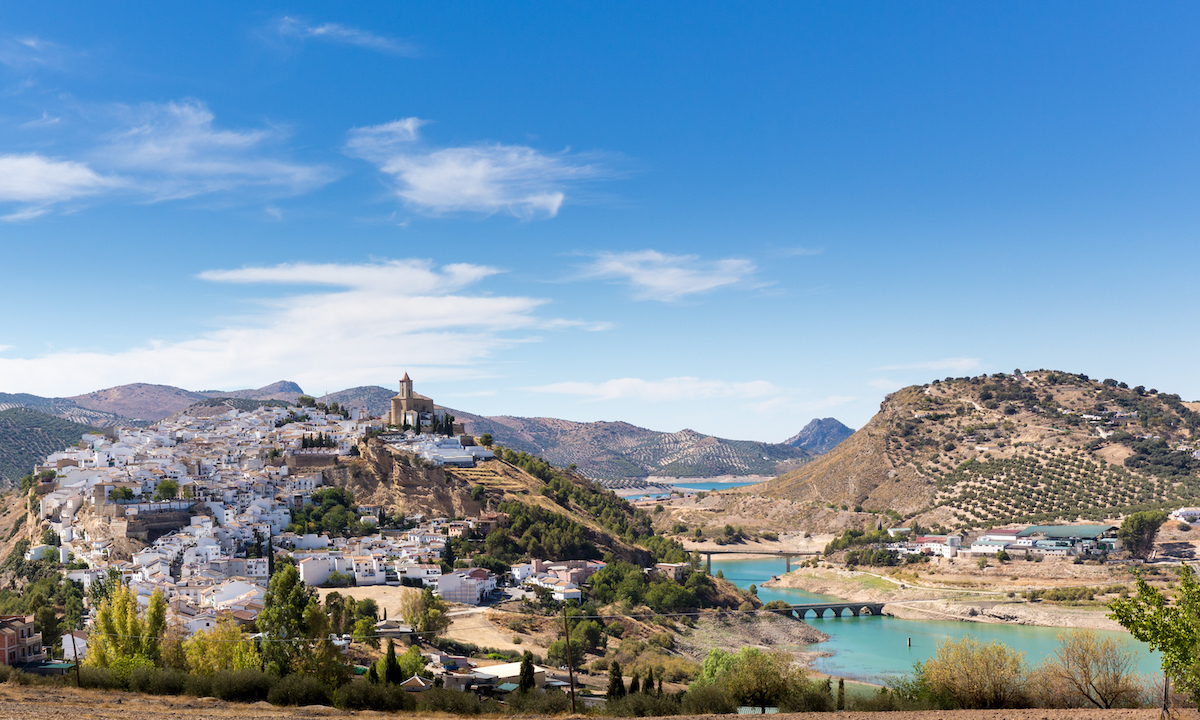
Iznájar. The dam is the largest body of water in Andalucía & 3rd largest in Spain.
As already stated, the highest number of sales ever achieved in Spain in one year was 955,186 in 2006 but demand was already in decline before the 2008 global financial crash kicked in. The Spanish building boom was fuelled by cheap credit and speculation and the bubble was always going to burst at some stage, the global meltdown just helped it on its way. It is estimated that new construction declined by 95% in the aftermath of the crash and the capacity lost then is still impacting the property market nearly 20 years later.
The numbers speak for themselves. Spain is currently completing around 100,000 units per year, about 40% below what is needed to cover new household formation, never mind demand for second homes from both domestic and foreign buyers, plus the rental investment sector. In October 2024 the Bank of Spain estimated that Spain was lacking 600,000 properties just to cover new household formation since 2021, when it says the demand/supply ratio became seriously uncoupled. New household formation is currently around 275,000 annually, a figure predicted to rise to around 330,000 by 2028. The shortfall seems set to continue.
Before starting to dig into the statistics and apply them to the property market and related issues it’s perhaps worth taking a look at why Spain is such a draw for so many overseas buyers.
Why Andalucía?
Andalucía is not only Spain’s largest autonomous region, it is one of the most varied. It has both Mediterranean and Atlantic coasts, a vast, mountainous interior, and five of Spain’s most historic cities: Cádiz, Málaga, Seville, Granada, and Córdoba. Cádiz is thought to be the oldest continuously inhabited city in Europe, settled by the Phoenicians over 3,000 years ago, and the annual New York Times list of 52 places to see had Cádiz at number 50 in 2019. In November 2023, Forbes magazine reported on the annual poll by InterNations, a global community of people living and working abroad, which ranks the best cities in the world to be an ex-pat. Málaga was ranked #1. (Source:Forbes)
The Sunday Times has also highlighted great things to do in Andalucía, which have nothing to do with lying on a beach. For example, some serious hiking or discovering the triangle of iconic Andalucían cities. And the project to link the entire 185 kms of the Costa del Sol with a coastal path is progressing well. Andalucía really does have something for everyone, with lots of options for property buyers. It’s so much more than a sun ’n sand summer destination; everywhere on Spain’s Mediterranean and Atlantic coasts is good for that. There were clear signs from 2024 that more visitors are coming in what used to be thought of as low season, as Málaga overtook Gran Canaria to become Spain’s 3rd busiest airport in the Jan - March period.
However, many foreigners forget that only a small part of Spain’s Mediterranean mainland coast faces south, and it’s all in Andalucía. This helps explain why it is one of the very few places in Spain, indeed in Europe, with a genuine 12-month season. The micro-climate areas on Andalucía’s southern Mediterranean coast are buzzing all year round, particularly in the main golfing locations. That’s where you find the mildest winter temperatures on the European mainland. Meanwhile, on Andalucía’s Atlantic coast, there are some of the best wind and kite surfing conditions in the world throughout the year.
Head into the Sierra Nevada for Europe’s most southerly and sunniest ski resort, just 45 minutes from the coast. And it’s also one of Europe’s highest resorts with slopes between 2,100m and 3,300m above sea level. These altitudes mean it is usually open by the end of November and rarely closes before May. The resort is currently undergoing a 10-year investment programme to update infrastructure, including twenty new snow cannons. And when the snow melts in May? Then mountain biking, motocross, hiking, and other summer activities are on offer.
For sports enthusiasts, Andalucía is a dream location. There’s horse-riding on the coasts and in the sierras. Tennis year-round, scuba diving, wind and kite surfing, rock climbing, hiking, cycling, and mountain biking, snow skiing. They’re all there, with the perfect climate in which to enjoy them. But for Andalucía, the biggest sport of them all is golf.
Andalucía really does have something for everyone, with both Mediterranean and Atlantic coasts, a vast, mountainous interior and some of Spain’s most historic cities. The pretty ‘pueblos blancos’, the white villages in the hills, are a quintessential part of the Andalucían landscape. And for sports enthusiasts Andalucía is a dream location.
Spain Needs Overseas Buyers
With a 20% market share that’s led to all-time record numbers of overseas buyers in Spain year-on-year since the Covid pandemic disruption, it’s clear international buyers are an increasingly important part of the overall Spanish Property Market. This higher market-share has translated into a 40% increase in foreign buyer numbers since pre-pandemic 2019 while domestic growth has been slower over the same period, roughly 27%. One explanation for this is that the domestic market is much more mortgage-dependent than the overseas sector. Spain’s banking crisis post-2008 tightened lending criteria to such an extent that large deposits were required from domestic buyers, slowing down the recovery in that sector. At the same time it was virtually impossible for overseas buyers to secure a mortgage at all and, as a result, the overseas sector has been dominated by cash buyers, and still is, particularly at the higher end of the price range.
We now know that there were approximately 119,000 foreign buyers in Spain to the end of October 2025 and it seems likely that once we have the full-year total the previous record of 139,102 in 2024 will be broken. Since 2015 growth in the overseas sector has been between 1.5% and 3% annually but I calculate that 2025 is around 5.5% ahead of the same January-October period in 2024. We won’t know for sure until we get the total in February and I’ll update this report as soon as we know. But it’s not just the numbers and market share that give overseas buyers a prominent place in the property market In Spain, it’s what they spend and where they invest, and we have to dig deeper into the statistics to get to those figures.
Between pre-pandemic 2019 and 2026 the number of overseas buyers in Spain's property market is up by 40%.
Unpicking The Statistics
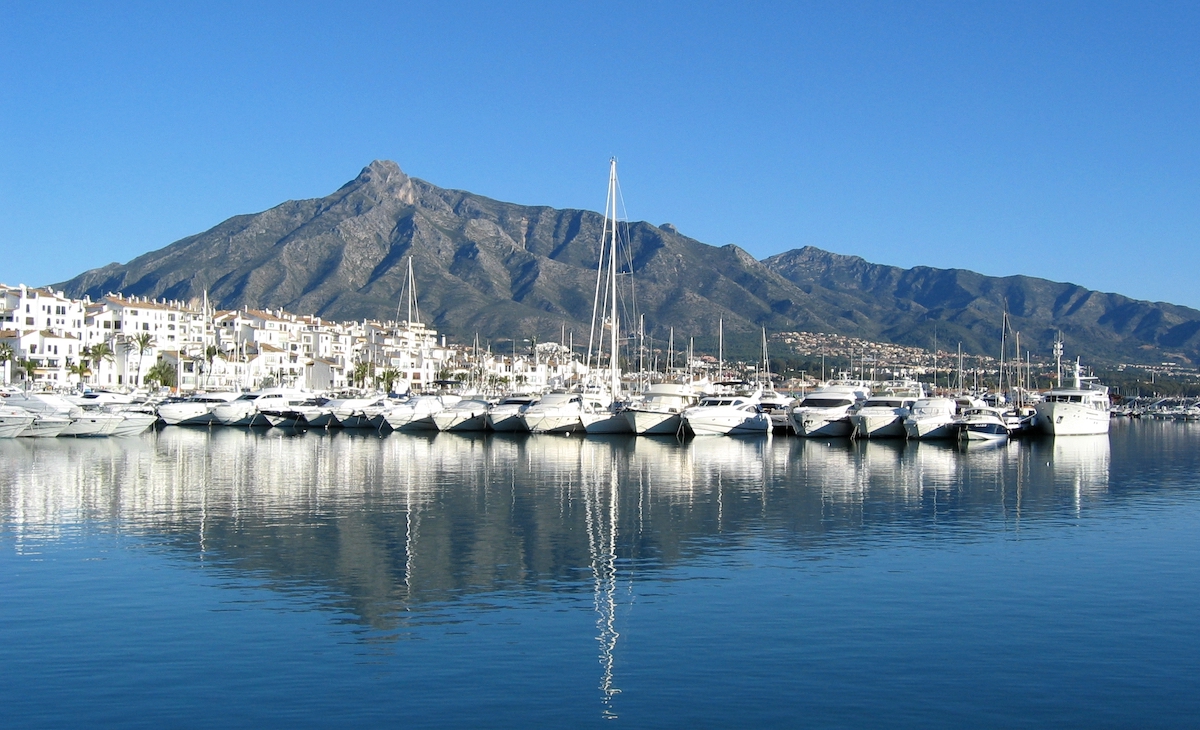
Puerto Banús with La Concha in the background
Until the post-pandemic surge of overseas buyers had died down it was difficult to see what the new normal might look like. Reports of 20%+ growth in the overseas market were wildly inaccurate and, in fact, there was no post-Covid boom as I explained in my blog. In my review of 2022 I said that we needed to see at least two more years of statistics to make a judgement and I think we do now know what normal is in the overseas sector.
These latest statistics clearly show the overseas sector of the Spanish property market has become a much bigger cake over the last decade. In fact, in the decade since 2015, nearly 1.2m overseas buyers have invested in the Spanish property market. In addition, the traditional markets from northern Europe have been joined by other nationalities that barely registered previously and the signs are that these groups will continue to grow. And while it was the case that much of the overseas sector was based on second home ownership, it’s now clear the balance has changed, with more purchases linked to permanent residence, either as retirees or working. For example, two decades ago 77% of British buyers were second home owners, today that has fallen to 60%, with 40% classed as resident foreign owners. And in just the last decade there’s been a noticeable shift in the overall overseas sector; in 2015, 51% of foreign buyers were non-resident second home owners, the 2025 statistics show that’s dropped to 38%.
We know that the Covid-19 pandemic changed a lot of things, not least the possibility for some of working from home and working from abroad. If home and abroad can be combined in Spain then the property market is likely to benefit long term.
Head For The Med
While overseas buyers have made up approximately 20% of the overall Spanish property market for several years, and 2025 was no different at 20.2%, the statistics also highlight that the overseas market is much more important in some locations than others, with much higher market share. It turns out that a key factor in where overseas buyers spend their money is the Mediterranean.
Spain is divided into seventeen autonomous regions but only five have Mediterranean coastlines; Cataluña, the Comunidad Valenciana, Murcia, Andalucía and the Balearic Islands and they dominate the overseas sector. In fact, when the statistics for the overseas buyer sector are unpicked we are really only looking at six regions. The five with Mediterranean coastlines are where 73% of overseas buyers invest and if the Canary Islands are added to the mix that rises to 82%.
The pull of the Mediterranean is even clearer in the case of those autonomous regions with some coastal provinces and some inland. Andalucía is a good example of this; four of its eight provinces have Mediterranean coastline and four do not. The four Mediterranean coastal provinces, Almería, Granada, Málaga and Cádiz, accounted for 72% of the 27,196 foreign purchasers in the region in 2025 so far. And Málaga province is way ahead of the other three, as the choice of 45.2% of Andalucía’s overseas buyers.
And it’s a similar story in Cataluña, with the three provinces with Mediterranean coastline - Barcelona, Tarragona and Girona - dominating the overseas market with nearly 90% of foreign buyers. Of the 19,500 foreign buyers to the end of October 2025, only 825 bought in the inland province of Lleida.
When the statistics for the overseas buyer sector are unpicked we are really only looking at six regions. The five with Mediterranean coastlines are where 73% of overseas buyers invest. Add in the Canary Islands that rises to 82%.
The Nationality League Table
The Notaries started counting foreign buyers by nationality in 2007. Prior to that we didn’t know much other than that there were lots and lots of Brits compared with other nationalities. By the 2006 peak, British market share was 27% of the foreign market and that translated to 23,500 purchases. However, we didn’t have an official count from the Notaries until 2007 and every year since then the British have been the nationality league leaders.
Although I keep expecting to see the British knocked off the top spot they are hanging in there. The nationality breakdown for 2025 so far left them in 1st place with 10,138 purchases, 8.5% of all foreign buyers. So far, so normal, but there are big changes happening lower down the league table. In previous years, I would have expected to see either the French or Germans in the next two spots, they switched around on a regular basis but not any more it seems. Buyers from Morocco took 2nd place, with 9,163 purchases and 7.5% foreign market share, Italians on 8,520, pushing the Germans down to 4th place with 8,163 (6.86% market share) and Romanians 5th.
What really stands out about the nationality statistics now is just how much some markets have expanded in the 19 years since 2007 when the Notaries started collating where the overseas buyers were coming from. For example, in that year there were just 1,003 German buyers and only 330 from the U.S. Prior to the pandemic, US buyers were well under 1,000 annually but in every year since the pandemic US buyers have exceeded 2,000 and if the second half of 2025 matches the first half they will top 3,000 transactions for the first time. In terms of property investment, Spain in now a global property market.
So having looked at where all these international buyers are investing their money and identified who the major players are, it’s time to focus on what they spend. This produces a rather different league table.
Prior to 2007 we didn’t know much other than that there were lots and lots of Brits compared with other nationalities. Although I keep expecting to see the British knocked off the top spot they are hanging in there.
Foreign Spending Power

The Pier at Playa Muro in Mallorca
Buyers from overseas have always spent more than domestic buyers and foreign non-resident buyers always spend more than resident foreigners. The new format of statistics from the notaries lack some of the detail necessary to analyse in depth so for this section I am reverting to their half-yearly statistics.
On average overseas buyers were spending €2,417 per square metre in 2025, up 7.6% on the year and 34% more than the domestic average of €1,804 pm2. However, when overseas buyers are separated into resident and non-resident groups, there’s a big difference; foreign residents are only 5.7% ahead of the domestic average while non-resident foreigners outspend domestic buyers by 73%.
The Big Spenders
In the case of the nationality league leaders, the British non-resident buyer is spending an average €2,795 pm2, up 12.3% year-on-year while resident Brits average spend pm2 rose only 1.6% to €2,442 in the same period. Buyers from the US represented only 2.2% of the overseas sector of Spain’s property market in the first half of 2025 but they headed the spending league table with an average spend of €3,465 per square metre, which rises to €3,697 pm2 for non-resident US buyers. However, they were knocked off the top spot by Chinese non-resident buyers spending an average €4,116 pm2 but 85% of all Chinese buyers are resident, spending approximately half of that figure - €2,081 pm2. And at the other end of the spending league table? That would be the Moroccans stuck firmly at the bottom with an average spend pm2 of only €747.
The Low Spenders
Those nationalities who are overwhelmingly resident in Spain dominant the league of low spenders, well below the average spend of domestic buyers. For example, over 98% of Moroccan buyers are resident in Spain. The economic migrant groups, such as Moroccans, Romanians, Bulgarian, Colombian and Ecuadoreans, are not competing with the higher spending foreign buyers on the Mediterranean coasts and on the islands. They are buying in urban areas in town and cities and in depressed rural locations and if anyone is squeezing out domestic buyers it is this low spending group.
At the start of 2025, the current Spanish government discussed bringing forward legislation to ban all non-EU, non-resident buyers from the property market, which, apparently, would solve Spain’s housing shortage. I think these statistics show what a ridiculous idea that is. Taking the average domestic spend of €1,804 pm2 it’s clear that overseas non-resident buyers, with an average spend of €3,465 pm2, irrespective of whether they are EU or non-EU citizens, are not competing for the same properties with the average domestic buyer. And as almost all the foreign buyers at the lower end of the market are resident economic migrants, any legislation banning non-residents from the market wouldn’t apply to them in any case.
Given the difficulties the minority Sánchez government is experiencing I think it is safe to assume the plan to ban certain groups from the Spanish property market is not at the top of its ‘to do’ list for 2026.
The Regional Hotspots
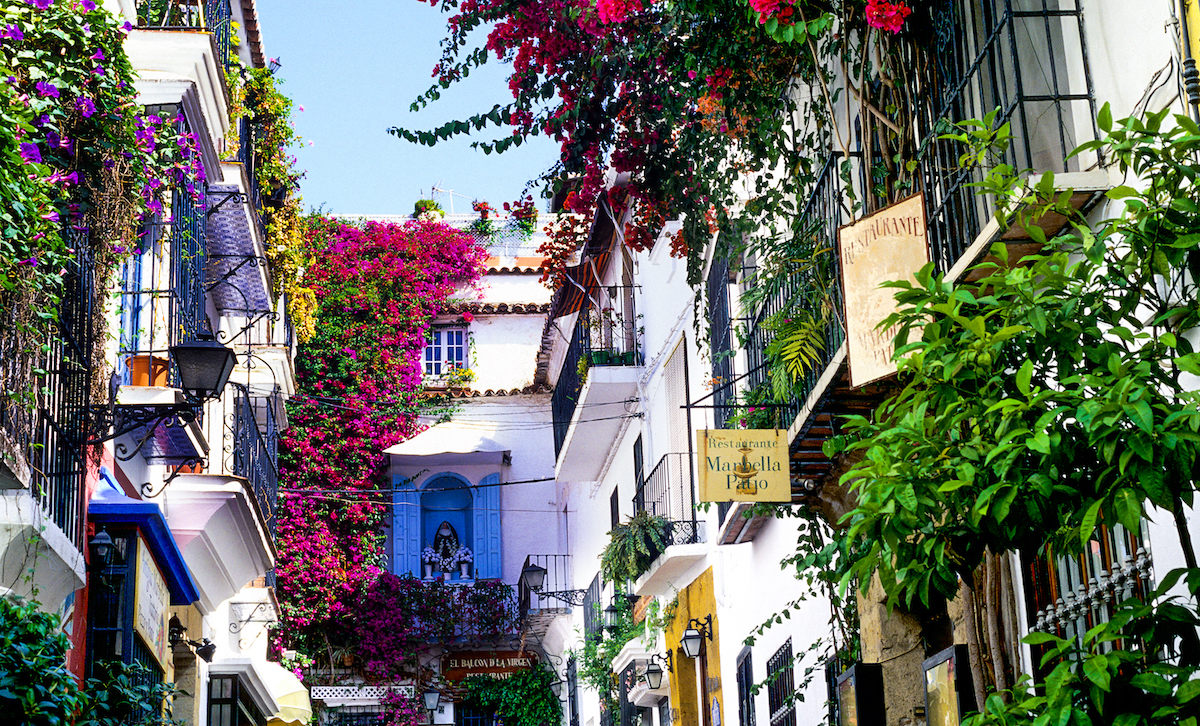
Marbella's historic Old Town, flower-filled streets and Roman and Arab remains
In terms of overseas buyer spending power all the overseas buyer hotspots saw increases in the average amount paid by foreigners per square metre in 2025. And to get a sense of just how much prices have risen recently, I’ve compared 2025 per m2 prices with pre-pandemic 2019. In the case of Andalucía it’s up to €2,775 pm2, a rise of 55.7% and Cataluña is up 30.2% to €2,556. And according to the notaries’ latest statistics, prices were up 7.88% in Andalucía and 5.45% in Cataluña in 2025.
And the most expensive autonomous region in the Mediterranean for overseas buyers? That would be the Balearics. After breaking through the €4,000 pm2 barrier in 2023 it has risen further in 2025 to €4,896 up an astonishing 57.2% since pre-pandemic 2019. In contrast, there is just one Mediterranean region where the average price paid by foreign buyers is well below the domestic buyer average and that is Murcia, on €1,439 per m2.
I’ve already commented on the statistics which show how the overseas sector of the Spanish Property Market is concentrated is just a handful of regions. And within those regions it is further fragmented at the provincial and municipal levels. A good example of this is Andalucía. Not only is it Spain’s largest autonomous region it is one of the most varied. It has both Mediterranean and Atlantic coasts, a huge, mountainous interior and five of Spain’s most historic cities; Cádiz, Málaga, Seville, Granada and Córdoba. In addition, this one region accounts for approximately 20% of all property transactions in Spain. So, in property terms it really has something for everyone but foreign sector activity is far from evenly spread. In reality it is actually concentrated in just a few locations.
Andalucía has eight provinces and while the 2025 overseas market share of 19.2% across the whole region was slightly below the 20.2% national average it turns out that in Málaga province, which really means the Costa del Sol, foreign market share was 42.9%, just ahead of the Balearics where it represented 38%. And while 34,104 foreign buyers represented 37% market share in the Comunidad Valenciana as a whole, in just one province, Alicante, overseas buyers were more than half the market, on 51.8%. (Source: MITMA)
Tourism & Rental Demand
The total of overseas visitors to Spain in 2024 broke through the 90m barrier for the first time with ease, reaching 93.8m, leaving the 100m barrier looking a bit fragile. With two months still to count and 85.7m already logged, 2025 is going to be close but not quite. I’m guessing it will be around 97m±, comfortably retaining Spain's position as the second most visited country in the world. In 2026, two more Spanish cities will have direct, non-stop flights from Newark,N.J. (EWR) three times a week on United Airlines; Bilbao and Santiago de Compostela. In addition, not only are the numbers up, international tourists are spending more. Does tourism have an impact on the property market? Very definitely as almost all have been tourists for years before they decide to purchase.
One reason for these extraordinary figures is that there are many more visitors out of the high season summer months. For example, the December 2024 total was 5.3m, January 2025 saw 5.1m and February 5.4m so it seems that 5m+ in low season months is the new normal. A decade ago around 3.5m a month was expected in January and February. Another factor behind the surge in numbers is the wider spread of nationalities, with strong growth from newer markets while the traditional, long-established markets, such as the British, Scandinavian and German markets remain the leaders. As with the nationality league table for property buyers the British lead the pack and by a big margin.
The statistics indicate that about 25% of international visitors looking for somewhere to stay do not stay in hotels, preferring to rent privately and current rental yields make letting a property to the tourist market in Spain an interesting option. And not just for the buy-to-let investor because although not all foreign owners are part-time landlords many are. They look for rental income to cover essential maintenance and running costs and taxes. Obviously there are many variables but the best gross yields can be as high as 10% and sometimes even higher for a large, top quality detached house in a prime location. Apartments and townhouses near the beach can return 6% - 8% gross, assuming a luxury interior. Typically, a quality property in a prime location will generate a higher yield in the short-term holiday market than the same property let long-term, in the region of 3% - 5% better.
However, there are always exceptions to the rule and growing demand for long-term rentals at the top end of the market can produce a gross yield similar to the short term yield. One of The Property Finders clients is seeing a 2019 purchase generating a gross yield of 8% as a long-term let. And just as the highest activity levels are at the top end of the property market so it is in the rental sector. Properties priced at €10,000 - €20,000 and up per week had no trouble finding takers in 2025 and high season weeks were fully occupied.
But there’s always a but and if rental income is part of your buying strategy then I would recommend you proceed with caution, particularly in city centres. The mood has changed and so has the law, new restrictions are coming thick and fast. City centre licences may disappear altogether - in 2024 Barcelona announced a total freeze on new licences and plans to phase out tourist lets completely from 2028 and in 2025 Málaga announced a 3-year freeze in saturated zones. In addition, away from the city centres, it seems likely that more apartment complexes will vote to limit or ban short term holiday lets and even in developments with no restrictions owners must get permission from the Community of Owners before renting to tourists. These changes mean detached houses and townhouses are the best bets for rental income. For more on the issues and proposed solutions see recent blogs here: A Global Problem and Local Solutions. For a real horror story on the damage to quality of life if you buy in a building with tourist rentals read my Home or Hotel blog.
If rental income is part of your buying strategy then I would recommend you proceed with caution, particularly in city centres. The mood has changed and so has the law, new restrictions are coming thick and fast.
The What - New Build v Resale

An infinity pool on the cliffs at La Herradura, Costa Tropical
The 2025 statistics show that across the whole Spanish market resales accounted for 91.3% of transactions and new-build 8.7%, That’s a very different scenario to the building-boom days of 2006 when the new-build sector dominated with as much as 40% of the market. Worse still, many of these properties were of poor quality and in inferior locations and when the inevitable crash came Spain was left with an overhang of 1.5m unsold properties. Spain’s ‘bad bank’, SAREB, established in 2013, was tasked with shifting this stock within a 15 year period and its liquidation is planned for 2027.
For reasons I have never quite understood, foreign buyers are like moths to a flame if new-build is available, even when the location is inferior. The fact is there is very little raw building land available in the very best locations, it was built on years ago. Consequently, it follows that much of today’s new-build activity is not in prime locations. In addition, plots and constructed square metres are being squeezed in comparison with resale product and some new villas are so close together on very small plots I struggle to describe them as detached.
I realise many buyers are not looking to make a huge profit in the short-term, they’ve made a life-style purchase. However, I’ve yet to meet one who is happy with the idea of a loss even before they’ve got the keys. In fact I think some buyers have been paying such inflated prices for new build properties that they may never see a return on their investment no matter how long they hold it. There’s always been a premium to be paid for new property but the discrepancy between new-build and resales prices in the current market is as extreme as I have ever seen in over 25 years in the property business in Spain. The latest statistics show the average price nationwide for resales is €1,815 per m2 while it is 49.4% higher for new-builds at €2,712.
A deficit in the new-build supply side inevitably puts pressure on the resale sector. Even before Covid-19 arrived there was a supply side shortfall in the quality resale sector in prime locations and this has been exacerbated by the increase in international buyers entering the market over a short time period without a similar surge in supply. And what they are looking for, high quality properties in top condition in prime locations is precisely what is in such short supply and I don’t see the demand/supply imbalance changing any time soon.
Buying Right in 2026
My advice to potential buyers in Spain is the same this year as in previous years. The location must always be key. Shiny new stuff, whether it’s a house or an apartment, something on the coast, the city or in the country, never trumps location. Always get the location right and then do the best with the available budget even if that means adjusting expectations. For example, several recent clients of The Property Finders have chosen a semi-detached property, rather than the detached house they initially wanted, in order to stay in a really prime location. In my view, that is always the best decision. If they had stuck with their preference for detached they needed to accept an inferior location to stay in budget. Never compromise on location.
My advice to buyers in 2026 is do not obsess about new-builds, especially if not located in prime positions. Many are not. Consider equivalent resales, calculate the price per m2 to include any renovation if it’s needed. Then you can take an informed view on what makes the best financial sense. The result will almost certainly be a lower price, a bigger property and, most important of all, a superior location.
Don’t buy anything that is blighted. Roads tend to get busier over time so if it’s noisy now it will only get worse. If there is a mobile mast in view assume there will be more as the tendency is for them multiply. Electricity pylons are also a big no-no. We can assume new housing will increase in the long term, so it's essential to be aware of local planning issues and what might be in the pipeline. Already, in some areas I can count twenty cranes while standing still. If there is vacant land nearby find out with absolute certainty what, if anything, can be constructed. The selling agent saying it is green zone is just not good enough. Why risk losing a fabulous view?
And when I am assessing properties for my clients I always ask the following questions. If circumstances change and they need to sell quickly is the price right to enable them to do that? Secondly, is this a property for which there will always be demand irrespective of market conditions? One thing is certain; there will always be demand for top quality in prime locations. It always has been, still is and always will be about location.
The idea that the Spanish property market would experience a post-pandemic meltdown, similar to the market crash of 2008, quite clearly was wrong. In contrast, it has enjoyed increased interest and not just from long-established markets of British, Scandinavian and other European nationalities but from all over the world and it is now a truly global market. As already mentioned, overseas demand is pushing market share in the most prime locations way beyond the national average of 20%. The Spanish property market would certainly be in a very different place without overseas buyers.
And as to where prices are going in 2026, it really comes down to the demand/supply imbalance and I think we can be certain that if demand remains as strong as it is now and supply stays limited, prices are going in one direction only and that’s up. There’s also quite a difference depending on which level you’re looking at. The latest statistics give the overall market In Spain up 7.1% over the year and that’s replicated in Andalucía as a region, up 7.88%. However, when you dig down to the prime province of Málaga it’s up 13.1% and at the municipal level in Marbella is very similar, up 12.6% over the same period. Expect similar variations in other prime locations with higher price rises at local levels when compared with regional or provincial levels.
Nevertheless, if you buy at the right price, Spanish property is still relatively affordable. There's potential for substantial capital growth in the medium term and excellent rental yield potential. The sun continues to shine and the quality of life is rated one of the best in the world. And there’s no doubt in my mind that with the WFH and WFA options becoming a reality for many more people post-Covid, that home will be in Spain.
And finally, do your research - or, if you want independent, buyer-only advice, let The Property Finders do it for you. Watch our videos to learn more about the background checks and due diligence we undertake for all our clients. Our promise is that you will never see a property that we haven’t thoroughly checked, inside and out, before we recommend it.
©Barbara Wood
The location must always be key. Shiny new stuff, whether it is a house or an apartment, something on the coast, the city or in the country, never trumps location. Get the location right and then do the best with the available budget even if that means adjusting expectations. Never compromise on location.
view our socials
© 2026 The Property Finders, International Property Search & Acquisition Services. All intellectual property in the design, images and text of this website are and will remain the property of The Property Finders. Any infringement of our rights will be pursued vigorously.
GDPR 2018 - We guarantee the personal data entered in the contact form will only be used for the purpose of replying to your enquiry and will not be shared with any other company, service or provider

